
Blog | 23 Jul 2021
Will travel become less globalised in a post-pandemic world?

Travel and tourism, like many other industries, had become highly globalised in the years leading up to the COVID-19 pandemic. In 2019 long-haul travel—travel between major regions such as Asia-Pacific and Europe—accounted for more than 21% of all international trips. This was a record high that followed years of steady increase.
In the wake of the pandemic, travel has understandably become far more localised, due to a combination of travel restrictions, transport availability and economic impacts. The share of international trips accounted for by short-haul travel (such as within Western Europe) in 2021 is estimated to have reached its highest in almost two decades due to imposed limits, and consistent with disruption to global supply chains in various industries.
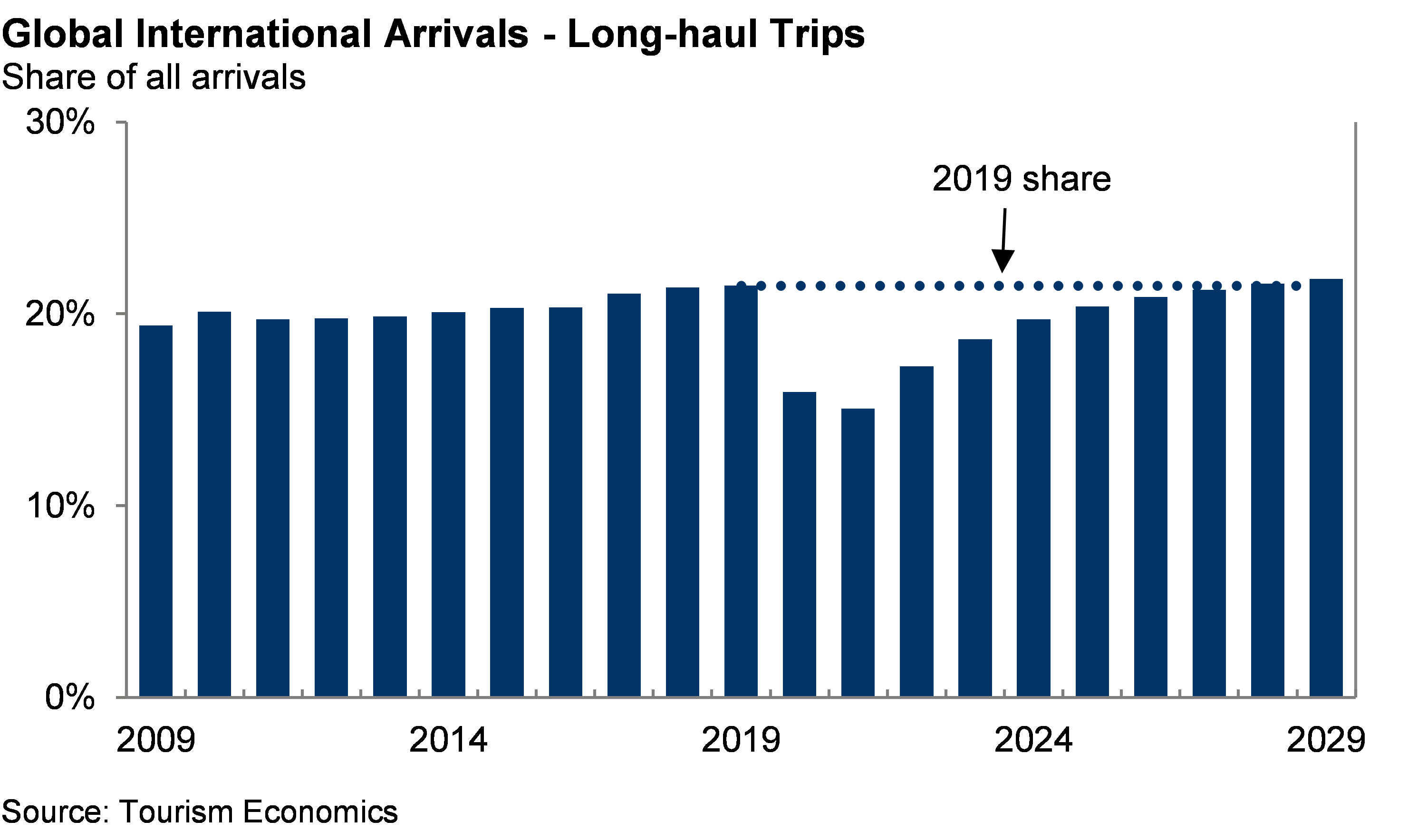 Does this mean that travel will become less globalised as a result of the pandemic? The answer, perhaps not surprisingly, is temporarily yes. Tourism Economics’ baseline projections suggest long-haul travel will not recover to its pre-pandemic share of international tourism until 2028. This recovery timeline reflects international travel restrictions in the near-term, and the subsequent hit to global economic conditions. While we don’t envision a permanent dampening of global long-haul travel in our baseline, the longer that restrictions remain in place and travel is limited, the greater the delay in the predicted timeline for a recovery to pre-pandemic conditions.
Which regions and countries will be most affected by shifts in travel patterns? Before the pandemic, South Asia, the Middle East and Africa relied most heavily on long-haul source markets, which suggests that these regions are more vulnerable to an increasingly localised travel environment. By contrast, Northeast Asia had the least exposure to long-haul travel, alongside Southeast Asia and Europe.
Considering the question from another angle, destinations that depend more heavily on short-haul travel are likely to see a faster and more stable recovery in inbound tourism, as discussed previously by Tourism Economics. This includes Western Europe, Northeast Asia and the Americas, which can also benefit from substitution of large existing outbound markets.
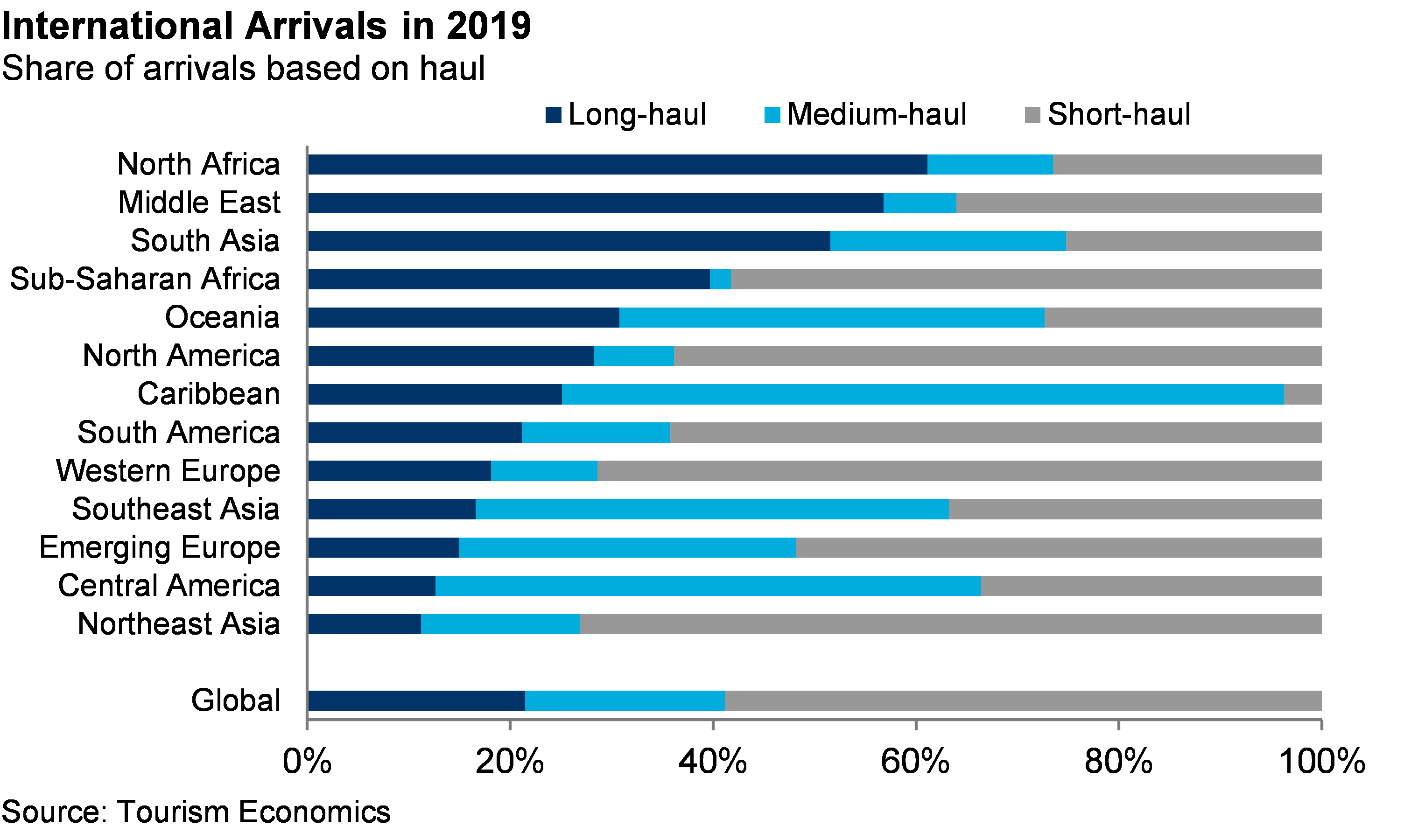 There is also a role for medium-haul travel, which is expected to recover more quickly than long-haul, but slower than short-haul. Oceania, for example, relies heavily on medium-haul source markets (i.e. those from elsewhere in Asia-Pacific), as does the Caribbean (from other markets in the Americas).
Ultimately, our baseline expectations are that travel will not become permanently less globalised due to the pandemic. But the longer the recovery is delayed, the more likely downside risks are to persist. In the meantime, destinations must rely on shorter-haul source markets and the domestic market—including via the substitution of outbound travel to “staycations” and domestic tourism—to support travel and tourism.
Tags:
You may be interested in

Post
Inside the UK’s Data Centre Boom: Why London Still Dominates—and what comes next
As AI accelerates and global tech companies commit billions to new cloud and data-centre projects in the UK, the country is cementing its role as a leading AI hub.
Find Out More
Post
The UK’s data centre boom: growth trends, drivers, and the rising power challenge
The UK is experiencing a remarkable growth in its digital infrastructure. Data centres—the facilities that house the servers and computing equipment powering everything from cloud storage to artificial intelligence (AI)—are expanding at an unprecedented rate and fuelling energy demand.
Find Out More
Post
Australia’s Infrastructure Outlook: Big Shifts, Bigger Challenges
Australia’s infrastructure landscape is shifting fast, driven by new investment trends, emerging asset classes and growing capacity constraints. This outlook explores the major changes ahead and what industry and government must do to navigate the decade effectively.
Find Out More